

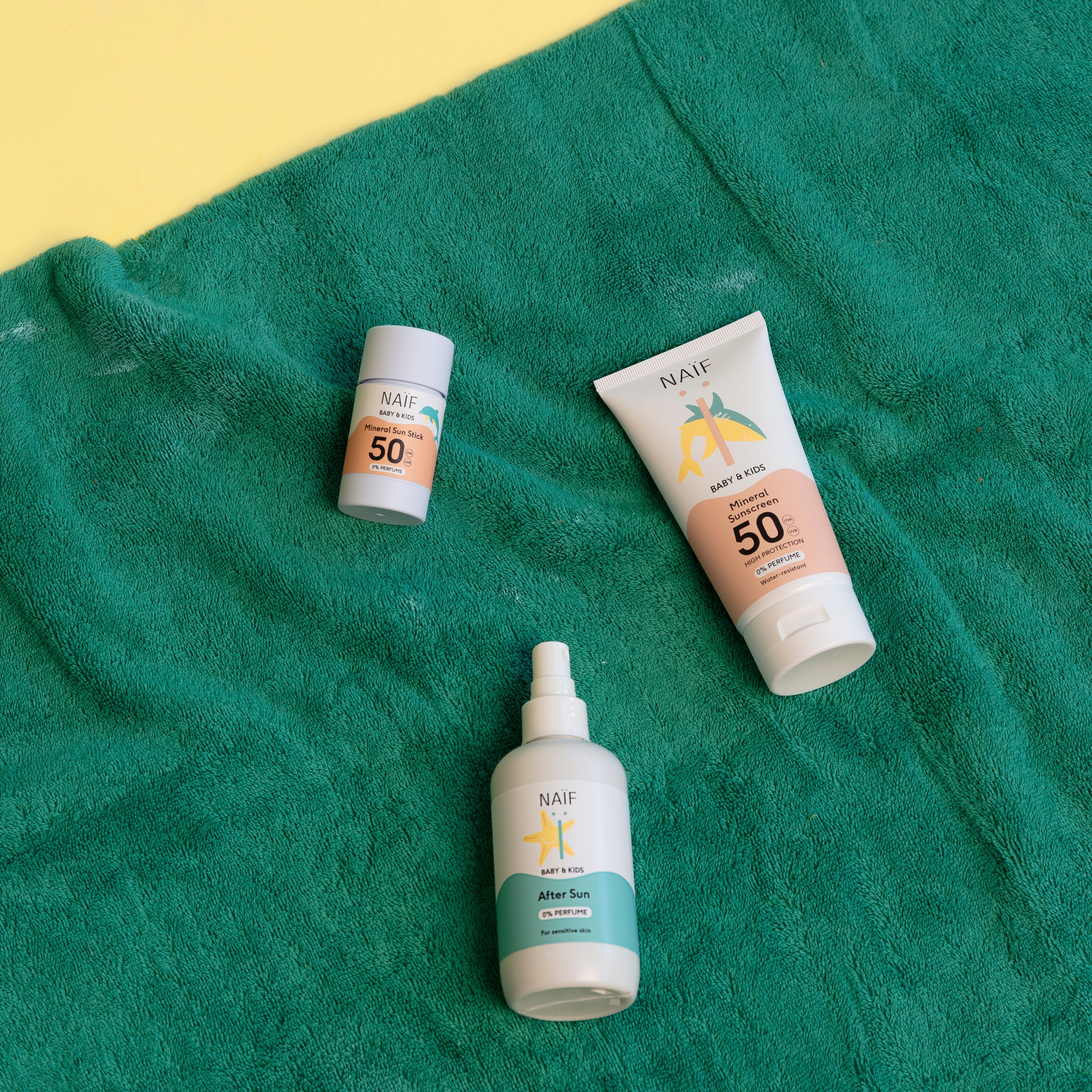
To prevent sunburn, it's important to protect yourself well. Shade, sleeves, sunscreen. We asked dermatologist Elodie Mendels how best to prevent your skin from burning in the sun and what to pay attention to. Here are some great tips so you can go out well protected this summer.
First of all, who is Elodie? Elodie Mendels is a dedicated academic pediatric dermatologist at the Erasmus MC-Sophia Children's Hospital. This means she helps children and their parents/caregivers with the treatment and management of various skin conditions. In addition to her work in practice, she also enjoys and finds it important to inform people through other channels with tips, tricks and solutions for skin problems.
Earlier we talked about sunburn and how to prevent it. You mentioned avoid, cover and apply. How exactly do you do that?
"How you do it exactly depends on each child, but the most important rules are: apply half an hour beforehand, so the sunscreen can dry well and a protective layer forms. Then repeat it every two hours. Every child is different, but generally they're more likely to go along with it if you involve them in the routine. Let them play with the stick or tube, for example, or apply it to each other. It's important to make sunscreen application really part of the daily routine."
"Also apply well under clothing, especially under thin rompers or clothing made of thin, loosely woven and light fabrics. With normal, tightly woven clothing this is not necessarily necessary, but then it is important that you apply well under the edges of the clothing. This is one of the most forgotten spots, along with: the tip of the nose, the chin, around the eyes, the edges of the ears and the lips. So don't forget these spots either!"
"You'd better avoid sunscreen spray for children. By that I mean a spray that mists in the air like perfume. These don't provide good protection because it disperses and little reaches the skin. It can also be dangerous to inhale the spray. Of course you can use a lotion-like spray that you spray on the skin and spread yourself."
What often goes wrong when protecting babies and kids from the sun?
"There are a few things that are often found difficult or forgotten during application. It can be difficult to integrate sunscreen application into the daily routine and apply it in time before we go out in the sun. Also, it's not always repeated every two hours or after swimming, while it's really important to repeat it. Sunscreen is wiped off quickly. Really don't forget to apply those spots I mentioned earlier! Apply a thick layer too, because a thin layer has much less effect. And finally, between 12 and 3 o'clock it's best to stay out of direct sunlight, although this can sometimes be a challenge. It's important to keep babies up to 1 year old always out of the sun."
How thick should you apply then exactly?
"People often think that with SPF30 you can stay in the sun about thirty times longer without burning. That's not quite how it works. The effectiveness of sunscreen SPF is determined in a laboratory. A specific amount of cream is used to test this. In practice, you never apply your sunscreen as thickly as in lab tests. How thick you should apply exactly is always difficult to explain. There are lots of tips, for example how many teaspoons you should use on which body part, but in the end no one really measures it that way. I used to say: apply as thick as a peanut butter sandwich, but everyone spreads a sandwich differently, so that advice doesn't really help either. It just comes down to applying it nice and thick and definitely not too thin. And repeat it every two hours and after swimming, then you should be good to go."
Don't you clog the skin when you apply such a thick layer of sunscreen?
"You can't clog the skin, you're just putting a layer on top. However, sunscreen residue can end up in your pores, causing inflammation and for example a pimple. If you're prone to that, buy a sunscreen that's a bit less oily. There are also anti-acne sunscreens."
"In principle, you can wash most sunscreens off with water in the shower or bath. You can also use a facial cleanser or makeup remover. If you can't get your sunscreen off completely, you can also use baby oil."
Does it matter what kind of sunscreen you use?
"The most important thing is that you use sun protection that you like to apply. If you like applying something, you're much more likely to use it often and well."
"There are two different types of filters in sunscreen: mineral and chemical*. A mineral sunscreen has a UV filter made from a natural product, such as zinc, but it's still processed with a chemical process in the laboratory. Chemical UV filters are made in a laboratory. Some people prefer not to use chemical filters anymore, because there used to be a number of UV filters that turned out to be harmful, like oxybenzone. Those have long been banned in the EU and the fear of chemical filters is unfounded. Both mineral and non-mineral filters remain on the skin, only mineral molecules are much larger, which is why mineral sunscreen is often slightly thicker. Sometimes the molecules are made smaller into nano-particles so no white haze remains and the cream spreads better**."
"Whether you use mineral or chemical filters doesn't matter, the most important thing is that you feel comfortable with what you apply. In the Netherlands you need at least SPF30, but SPF50 is even better. Especially because people often don't apply thick enough. Also choose a sunscreen with UVB and UVA filter. For young children, preferably use sunscreen without fragrance, they really don't need that."
"Water-resistant sunscreen stays a bit better in place because components are added that make it stick better to the skin. But it's definitely not waterproof. That's why it's important to reapply after swimming or sweating."
"In short: apply a cream you like, minimum SPF30 and with UVA and UVB protection."
*At Naïf we prefer to call this non-mineral, why exactly you can read here.
**At Naïf we don't make the molecules smaller into nano-particles. That makes our sunscreen non-nano. How it works exactly with nano and non-nano sunscreen you can read here.

