

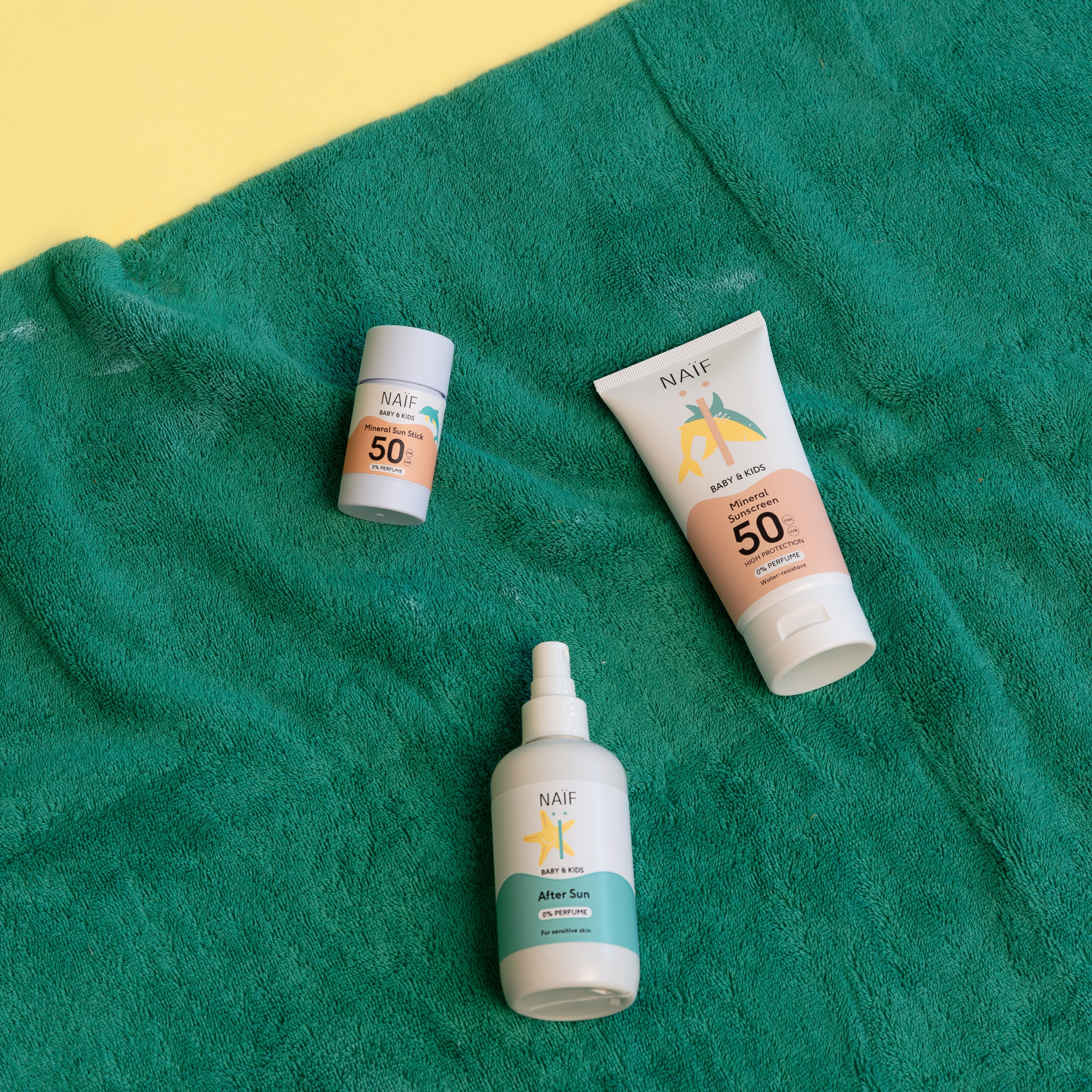
When choosing your sun protection, you're probably looking at the SPF (or factor) on the packaging. You might think: the higher the better, right? And we all know that SPF 50 is higher than SPF 30 or SPF 15. But what does that number actually mean? And which factor do you and your mini('s) need to be well protected on the go? No worries, we'll explain it to you!
What is SPF?
What does SPF actually mean? SPF stands for Sun Protector Factor. It is literally the factor that indicates how well you are protected. A sunscreen protects the skin against a large portion of UV radiation, but a small amount of UV radiation will always pass through. With an SPF 30, 96.6% of UVB radiation is blocked and with an SPF 50 even 98%. But what does this have to do with burning? With an SPF 30 that is applied correctly (sufficient amount and every two hours), your skin will burn 30 times less often than without protection. And with an SPF 50 that is (as you might guess) 50 times less. The effect of an SPF is thus also dependent on how your skin reacts without sunscreen.
UVA and UVB
There are two types of UV radiation: UVA and UVB. SPF protects against UVB, this radiation causes you to burn. But it is just as important to protect yourself well against UVA - the radiation that accelerates the skin aging process. No burning, but skin damage. Fortunately, there is sunscreen that protects against both UVA and UVB, so always look for that!
Need a memory aid for the difference between UVA and UVB? UVA rays cause skin aging: the A for Aging. UVB rays cause sunburn: the B for Burning. Now you'll never forget it!
Which factor do you need?
Good to know is that no sunscreen offers 100% protection against the sun. For adults, the Dutch Skin Foundation recommends using at least factor 30 on a summer day and reapplying every 2 hours. Sunscreen with a UV filter based on zinc oxide (mineral) creates a small layer on the skin that reflects UV radiation. Over time, this layer is damaged by friction, sweat and swimming. It is therefore important to reapply protection regularly, even with a water-resistant sunscreen.
For babies* and children, the advice is to use factor 30 or 50. Depending on your mini's skin type. In addition, the Dutch Skin Foundation recommends not only using sunscreen but also avoiding, clothing and applying. So keep your kids in the shade as much as possible and wear covering (or UV-protective!) clothing and put on a hat or cap.
*For babies up to 12 months, the advice is to keep them out of the sun as much as possible.

